
Who’s Who in the Hospital?

A Student Nurse’s Guide to Doctor Levels in Australia
5 min read • Placement • Updated May 2026
The hierarchy of doctors in Australian hospitals can be confusing at first.
Here’s a simple breakdown of the levels of doctors you’ll hear on placement.
Intern
An intern is a doctor in their first year after graduating from medical school.
They are fully qualified doctors, but they’re still completing supervised training to gain general registration.
Typical responsibilities:
Writing notes
Ordering scans and blood tests
Completing discharge summaries
Reviewing stable patients
Prescribing medications (with supervision)
Interns are often very approachable because they’re learning too. They may ask nurses for practical guidance about ward routines, equipment, or workflows.
If you’re worried about a patient and the intern seems unsure, it’s completely appropriate to escalate further.
Resident Medical Officer (RMO) / Resident
After internship, doctors usually become Residents (sometimes called RMOs).
This stage usually lasts a few years while they rotate through different specialties like surgery, emergency, ICU, paediatrics and mental health.
Typical responsibilities:
Reviewing deteriorating patients
Managing day-to-day ward issues
Writing treatment plans
Communicating with senior doctors
Responding to clinical concerns
Residents often become the “workhorse” doctors of the ward. You’ll speak with them frequently during shifts.
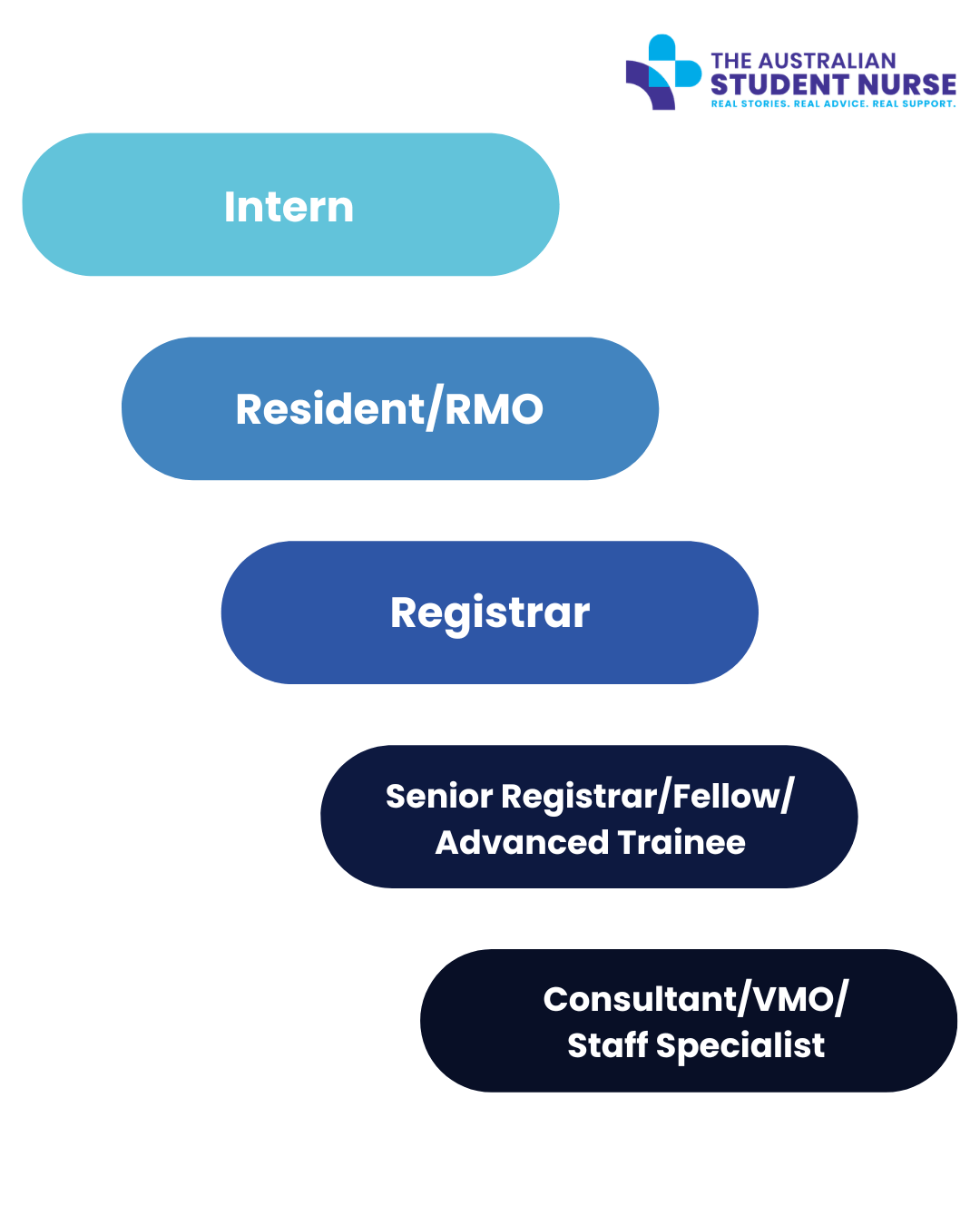
Registrar
A registrar is a doctor undertaking specialist training in a chosen field.
Examples include:
Surgical registrar
ICU registrar
Paediatric registrar
Emergency registrar
This is a more senior role with significantly more responsibility.
Typical responsibilities:
Making higher-level clinical decisions
Leading patient management plans
Performing procedures
Supervising junior doctors
Responding to emergencies
Registrars are often extremely busy and may cover multiple wards or departments. When nurses escalate concerns to a registrar, it usually means:
The patient is more complex
The issue is urgent
Junior doctors need support
Registrars are often the key decision-makers overnight.
Senior Registrar / Advanced Trainee / Fellow
Some specialties have doctors who are nearly finished specialist training.
These doctors:
Have years of experience
Function almost at consultant level
Often supervise juniors heavily
The terminology varies between specialties and hospitals.
Consultant / Staff Specialist/ Visiting Medical Officer (VMO)
A consultant is a fully qualified specialist doctor. Sometimes you might hear them called simply a "boss".
This is the senior medical role most people picture when they think of a specialist - e.g. cardiologist, surgeon, intensivist, psychiatrist.
Typical responsibilities:
Final clinical decisions
Leading medical teams
Complex procedures and surgeries
Supervising registrars and residents
Overall responsibility for patient care
Consultants may not spend much time on the ward, but they are ultimately responsible for the patient’s management.
During ward rounds, consultants often move quickly. Student nurses can learn a huge amount by listening carefully to the discussion during ward rounds, including their clinical reasoning and priorities of care.

Important Things Student Nurses Should Remember
1. Junior doesn’t mean incapable
Interns and residents are qualified doctors. They simply have less experience.
2. Nurses are often the continuity
Doctors rotate constantly between wards and specialties. Nurses frequently notice subtle deterioration first because they spend more time with patients.
3. Escalation matters
If you’re concerned about a patient:
Start with the appropriate doctor
Escalate if needed
Follow your hospital’s chain of command
Good clinicians escalate early.
4. Every specialty works differently
An ICU registrar may function very differently from a surgical registrar. Over time, you’ll learn the culture and structure of each team.
Final Thoughts
As a student nurse, knowing who does what can help you:
Escalate concerns appropriately
Build professional confidence
Understand ward dynamics
Learn faster on placement
Understanding the medical hierarchy isn’t about status — it’s about communication, safety, and teamwork.